Payment Method Discoverability - Amazon
Payment Method Discovery Across the Shopping Journey
Problem Statement
Flexible payment options on Amazon MENA were invisible until checkout — by which point most customers had already decided to leave.
In one of the fastest-growing markets for instalment payments, customers couldn't discover or evaluate flexible payment options until the final checkout step — far too late to influence their purchase decision. Affordability signals were absent at Search, the Product Detail Page, and Cart: the three moments where purchase intent is actually formed. Options like instalments and bank-linked offers existed, but without surfacing them earlier, they had no effect on conversion.
This led to the Instalment & Payment Discovery initiative: a redesign of how payment methods are surfaced across key pre-checkout touchpoints — Search, PDP, and Cart. The goal was not just visibility, but delivering contextual, personalised, and timely affordability cues at the moments that shape whether a customer buys at all.
Pre-launch research projections, validated via 22 moderated sessions & prototype testing — full methodology below
Opportunity
The MENA region is a uniquely high-opportunity market for payment innovation. Instalment adoption in the UAE alone grew 65% year-on-year through 2023–24, with providers like Tabby and Tamara acquiring millions of users. Yet Amazon's payment discovery experience had not kept pace with this behavioural shift.
The data told a clear story: customers who encountered instalment options before checkout were 2.4× more likely to complete a purchase using them. The challenge wasn't building a better checkout — it was redesigning discoverability for the entire pre-checkout journey.
Customer Pain Points
Through session recordings, funnel analysis, and 22 in-depth user interviews across UAE, Saudi Arabia, and Egypt, five structural pain points emerged — each compounding the others and collectively suppressing instalment adoption across the platform.
Design Approach
This was not a simple "show more information" project. It required a new design logic — one that knew when to show payment options, which options to prioritise for each customer, and how to present them without disrupting the primary shopping intent.
We defined three design principles that governed every decision across the project.
From Pain Points to a Shipped, Multi-Touchpoint System
Six months of cross-functional design work, spanning Amazon MENA product, payments, legal, and three external instalment partners.
Kicked off with cross-functional alignment across Amazon MENA Product, Payments, instalment partners (Tabby, Tamara), bank partners (Al Hilal, HSBC, ENBD) and legal — mapping the current-state experience across 14 touchpoints and defining shared success metrics. In parallel, I ran 22 moderated interviews across UAE, KSA and Egypt and analysed 450K+ sessions to pinpoint exact drop-off points; eye-tracking on PDP confirmed 80%+ of users never scroll past the Add to Cart button, validating an above-fold placement strategy.
Designed 3–4 layout variants per touchpoint — testing copy framing (monthly amount vs partner branding), placement logic (inline vs overlay) and disclosure depth — reviewed with partners via weekly Figma prototype cadences. In parallel, worked with the personalisation engineering team to define the ranking logic behind payment surfacing: lowest monthly payment → linked offers → recently used methods → co-branded card upsell, covering 12 edge cases including ineligible products, cart thresholds and failed authorisations.
Led rounds of compliance review with Tabby, Tamara and bank stakeholders, resolving constraints on logo usage, interest disclosures, eligibility messaging and co-branding hierarchy. Maintained a centralised compliance tracker, closing 140+ annotations ahead of launch readiness.
Led a six-week A/B testing phase across three cohorts in UAE, then prepared final handoff with annotated Figma specs, interaction documentation and a component library extending the Amazon MENA design system. Shipped across Search, PDP, View Cart and Add-to-Cart Confirmation simultaneously to keep the journey consistent, with full product experience sign-off obtained prior to launch.
Solutions
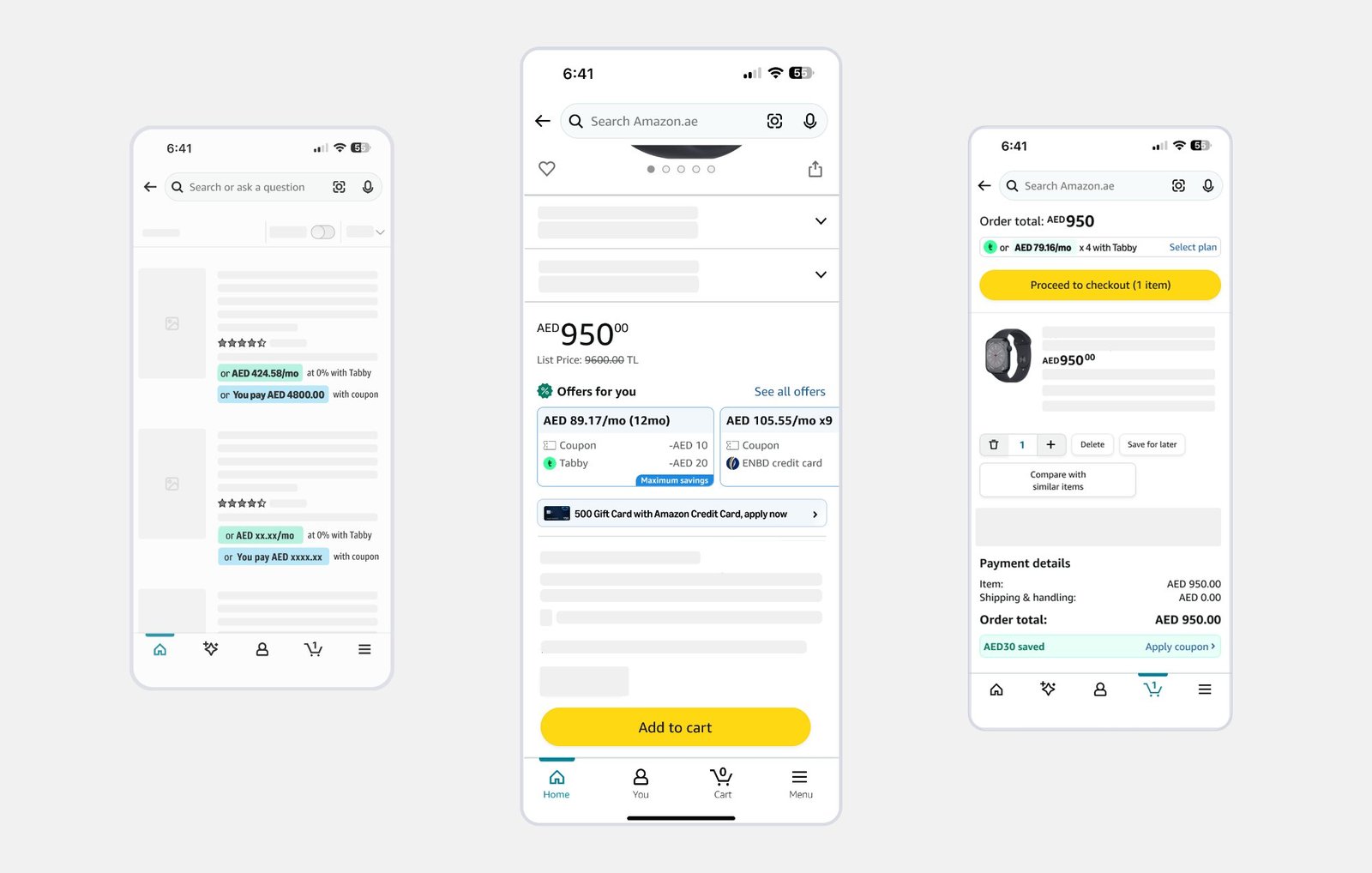
Following the four-touchpoint pain-point analysis, we designed a connected payment discovery system that threads instalments and bank offers through the entire upstream shopping journey — Search, PDP, HUC, and View Cart.
Each solution was built on the same three principles defined in the design approach: progressive disclosure, personalised payment ranking, and zero primary-flow disruption. Together they shift payment from a checkout-only mechanic into a discovery-stage conversion lever.
Instalment & Payment Discovery
- Instalments at search level can lift click-through by 18–22%; monthly framing reduces price-anchoring friction
- Eligible products gained improved visibility and ranking based on payment signal quality
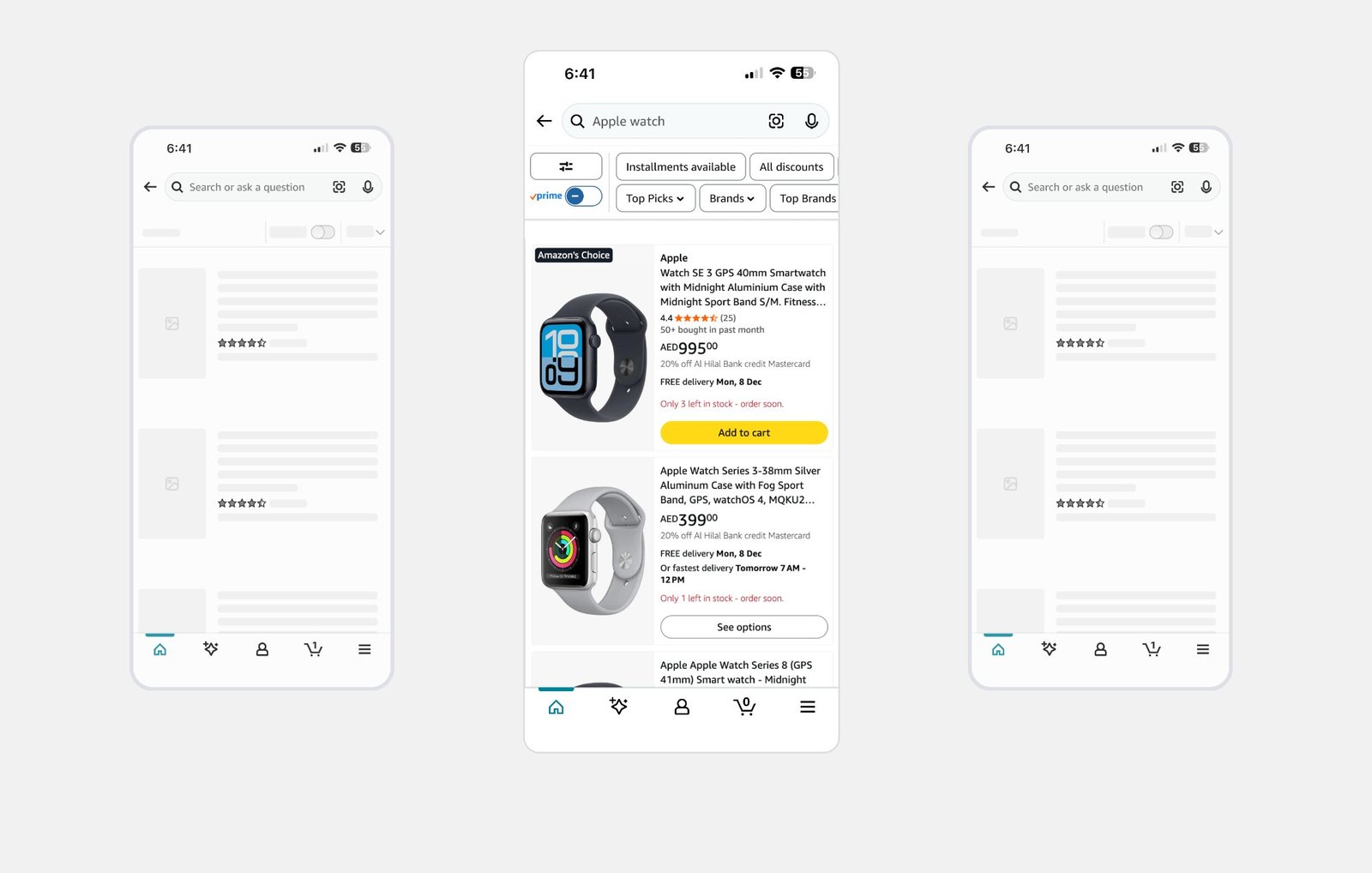
Before — no instalment or payment signal
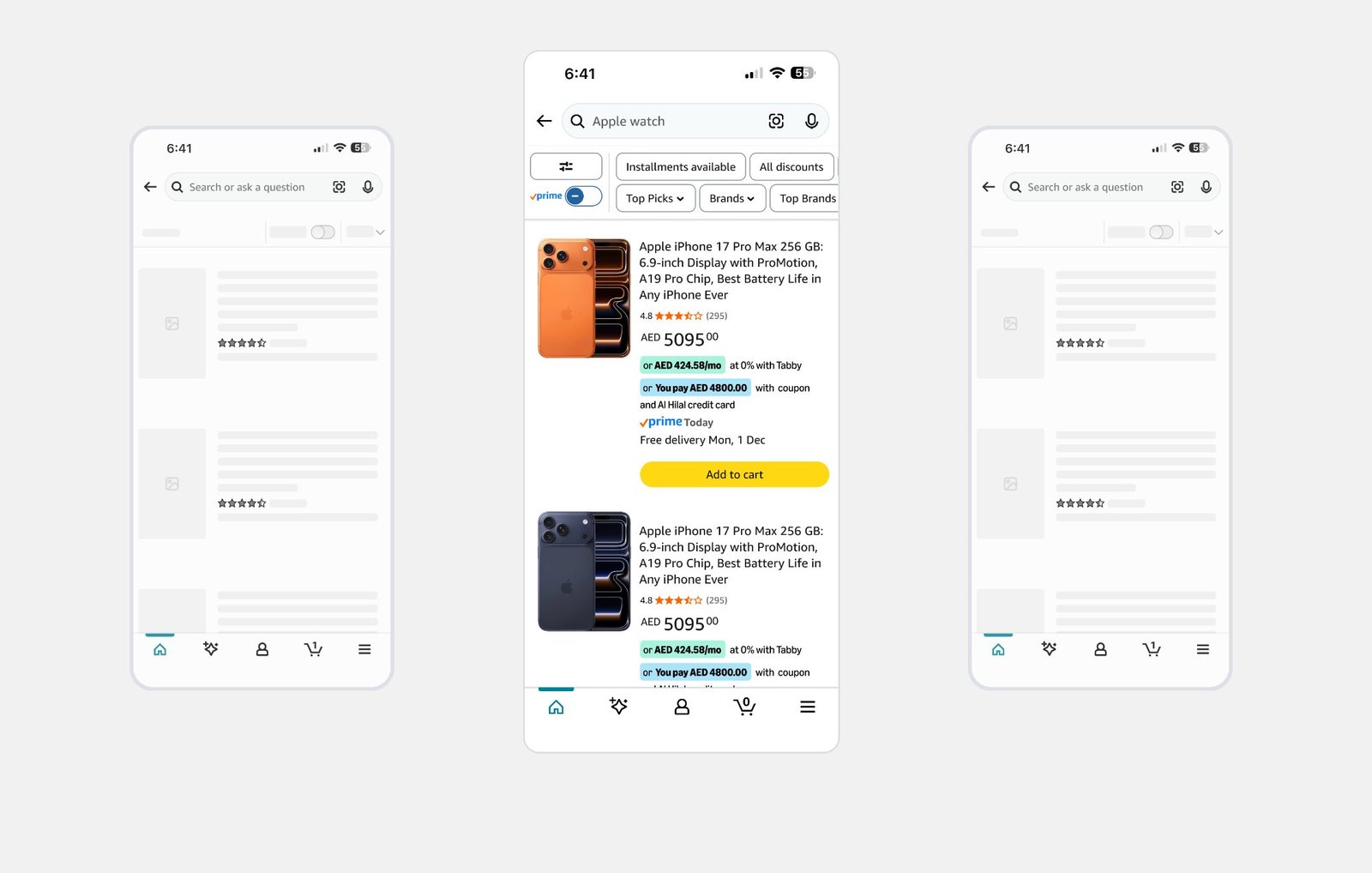
After — instalment & payment discovery
Offers & Instalment Discovery
- In A/B testing, surfacing “AED 89/mo” on the PDP reduced perceived price by 31% and lifted add-to-cart rate by 22% on items above AED 400
- Customers could combine offers to save up to 35%, previously invisible
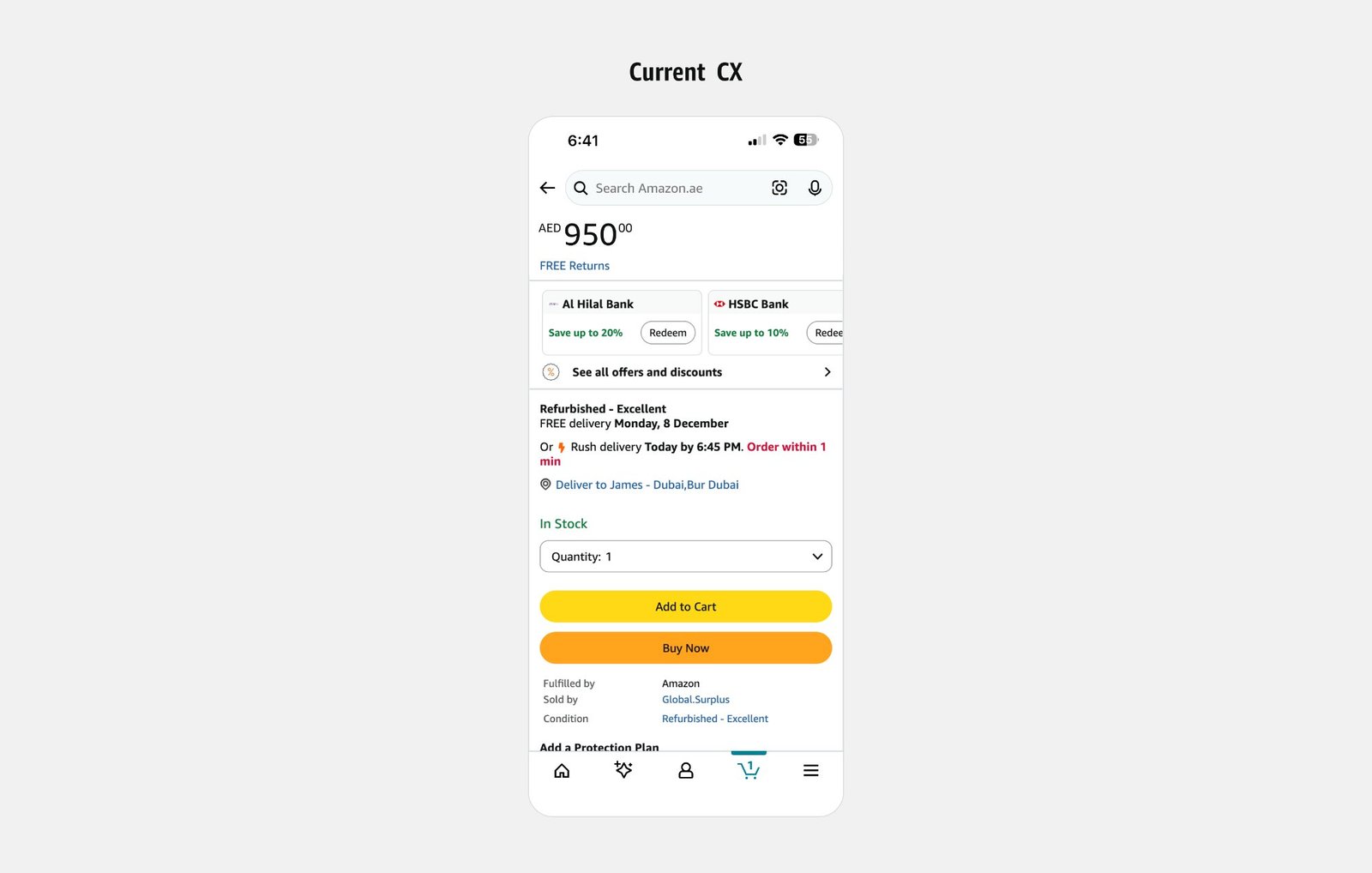
Before — payment buried below the fold
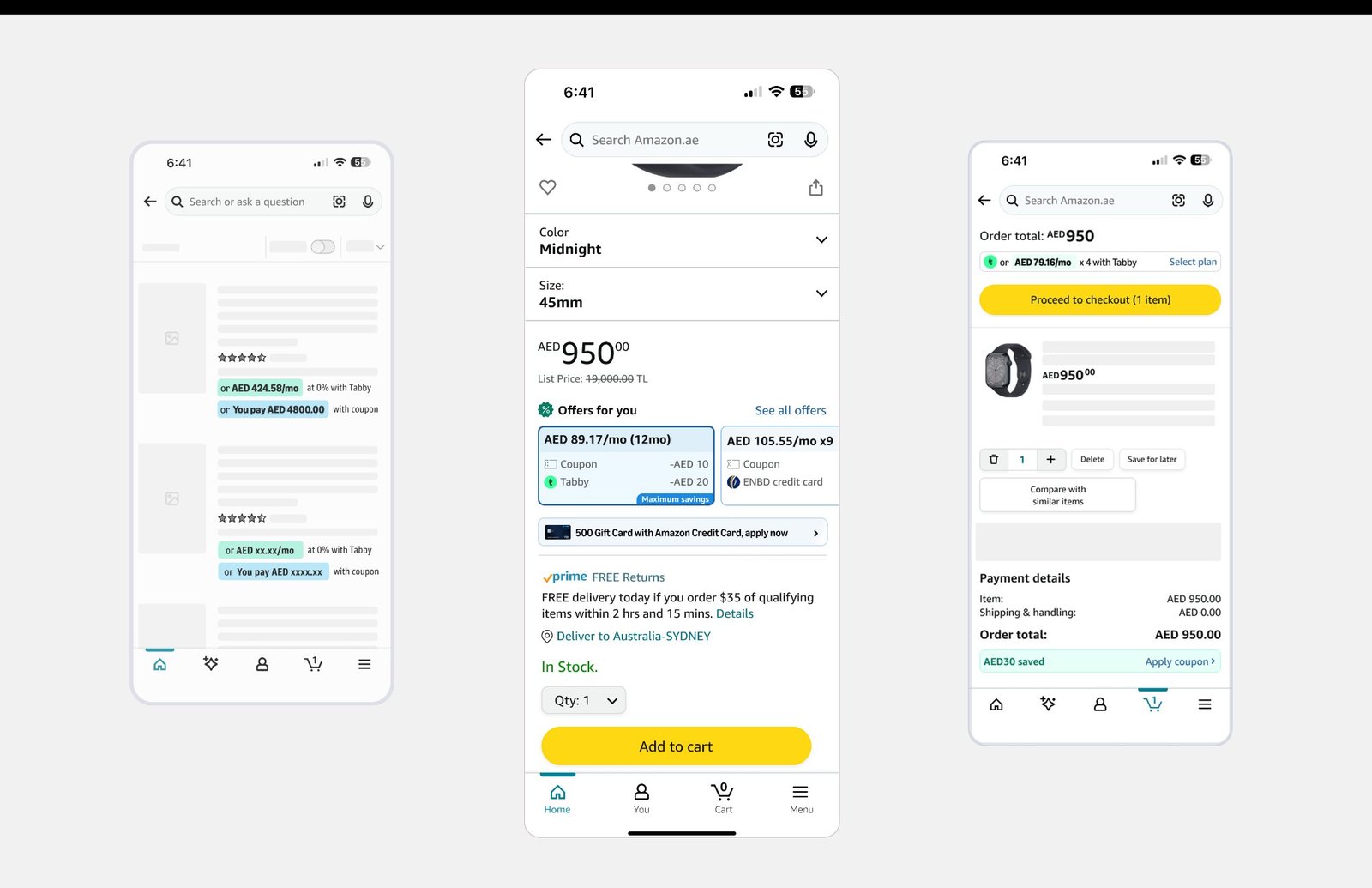
After — “Offers for you” row
Reachable Offers & Instalments
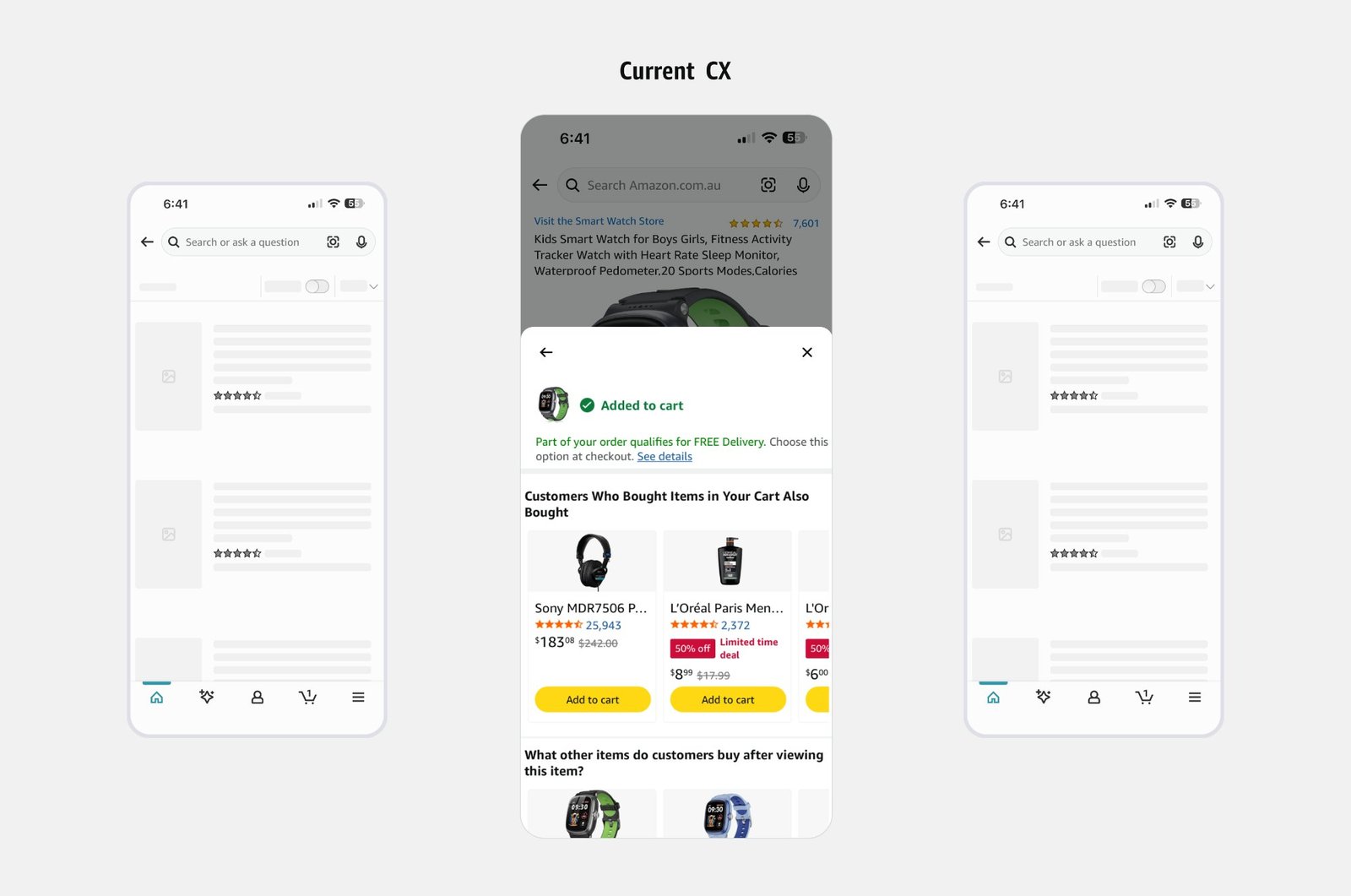
Before — no reachable-offer or instalment visibility at Add-to-Cart
Payment & Instalment Discovery
“I had no idea I could pay in four. I just saw the total and thought — that's a lot. If it said I could pay AED 237 today, I would have done it right there.”
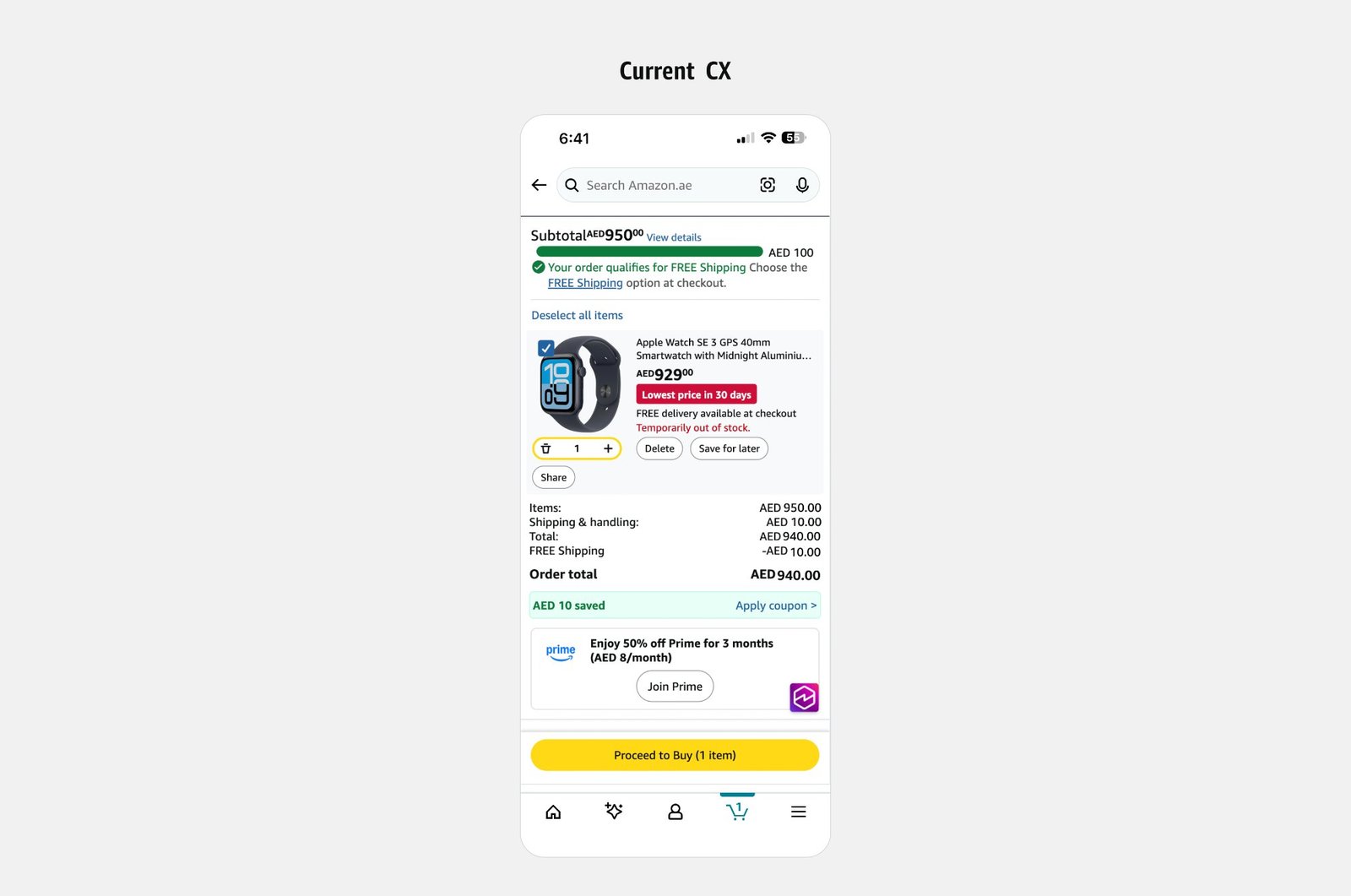
Before — no payment or instalment visibility
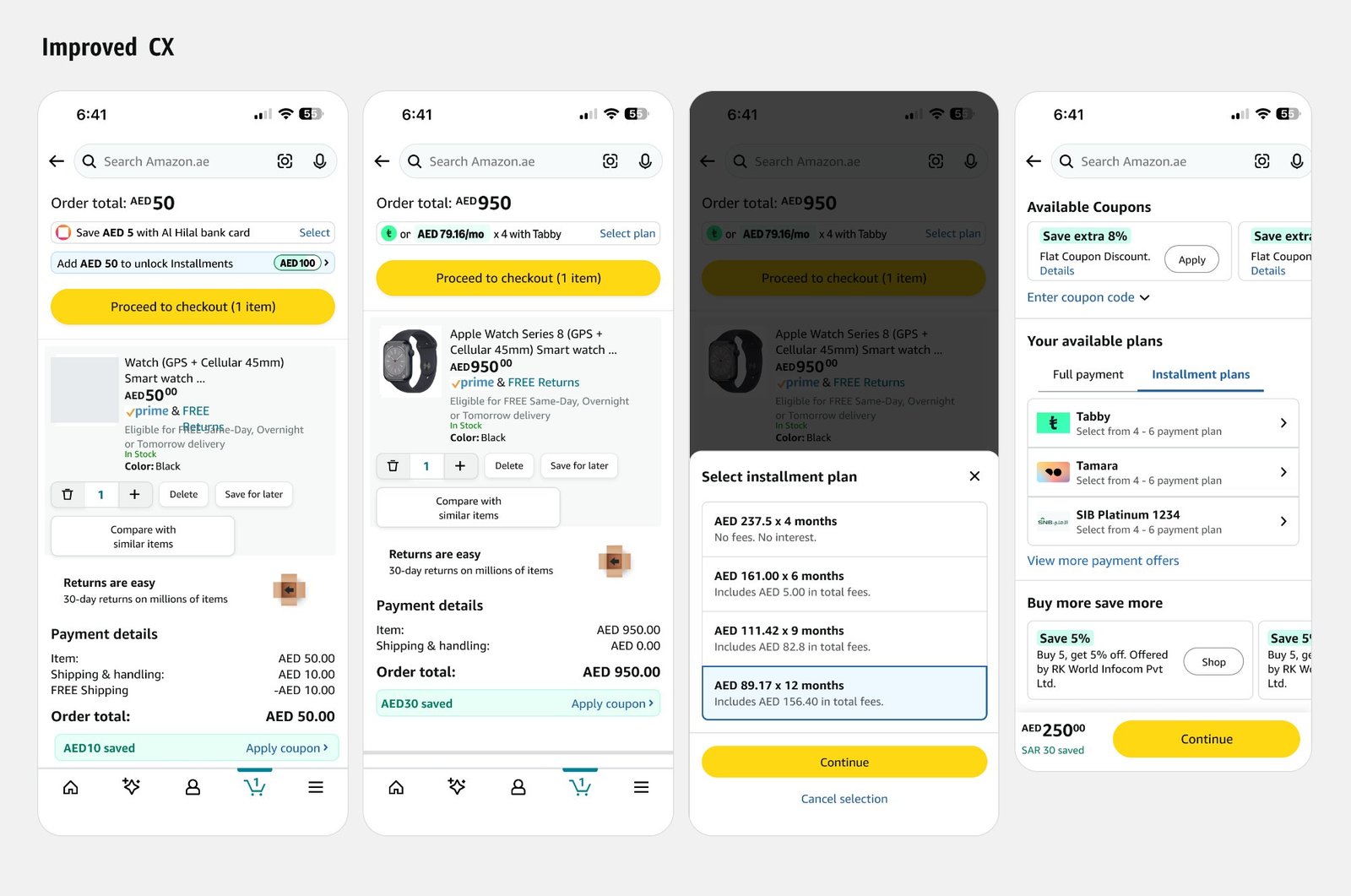
After — basket-building & instalment discovery
Prototype Walkthrough
An interactive prototype built for leadership alignment — demonstrating the end-to-end instalment discoverability experience across Search, PDP, and Checkout.
Projected Impact — Validated Through User Research
The redesign has not yet launched. In place of post-launch metrics, the figures below come from a structured pre-launch research programme: 22 moderated usability sessions across UAE, KSA and Egypt, task-based prototype testing, funnel analysis across 450K+ historical sessions, and intent-to-use benchmarking against comparable instalment markets.
Improving payment discoverability didn't just lift projected basket size — it rebuilt customer confidence, bringing previously lapsed instalment users back to a completed purchase inside the prototype.
Pre-launch · figures drawn from moderated usability sessions, prototype preference testing and historical funnel analysis. Live post-launch measurement is planned once rollout begins.